Keep the tote.
Kill the landfill.
We buy, grade, wash, rebuild, haul and recycle used IBC totes — and we are aggressively, almost unreasonably committed to the idea that a container built to last twenty years should not be buried after one trip.
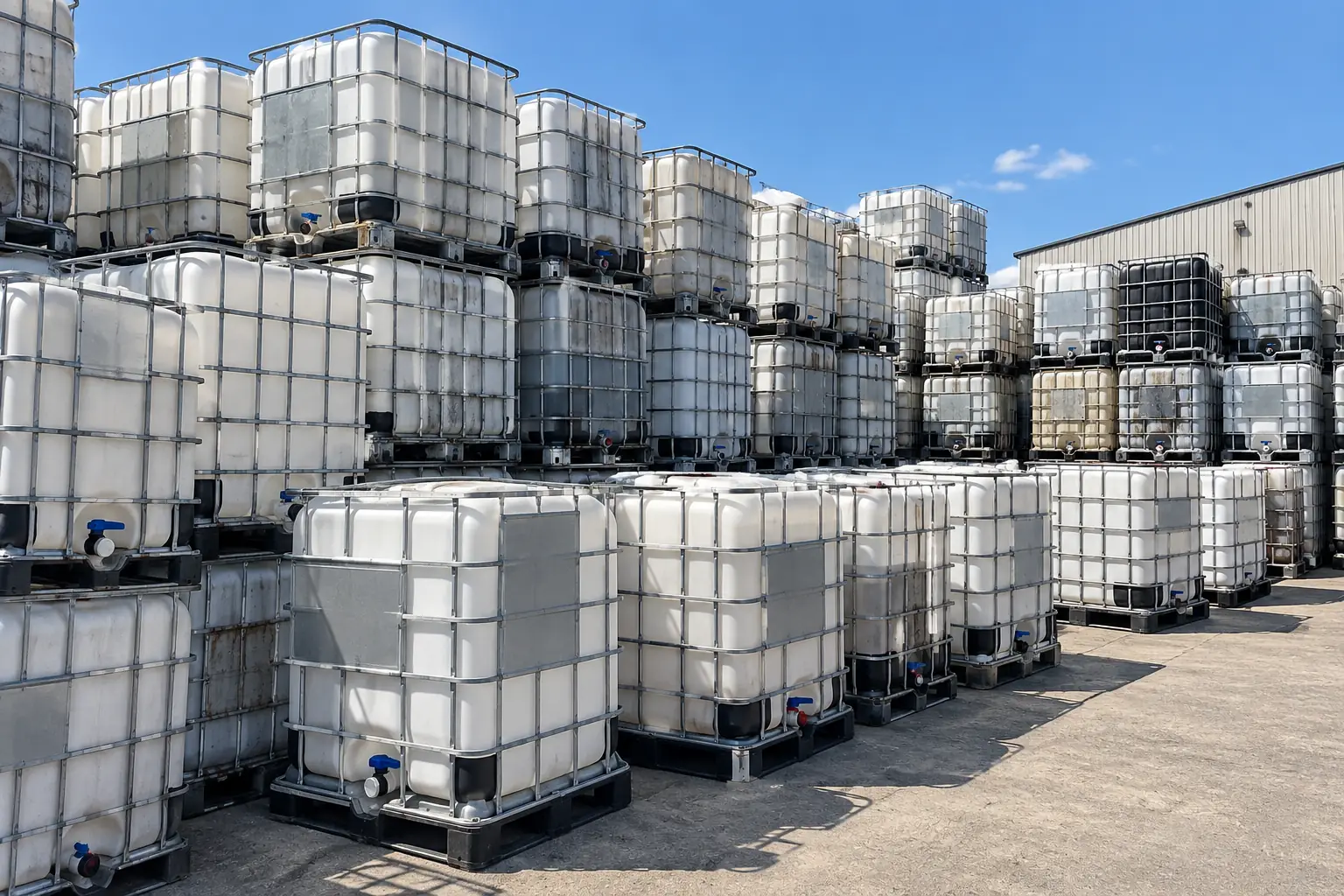
A used tote is not a compromise. It is the better engineering answer.
A composite IBC carries roughly 262 lb of CO₂e in its manufacture — resin, steel tube, galvanising, moulding, freight. That number is already spent. Buying the container second-hand costs the planet essentially nothing and costs you about a third of new.
The containers themselves are built for 5 to 8 years of service and routinely survive three or four of them. The thing that ends a tote's life is almost never the plastic — it is a $14 valve, a crushed pallet runner, or a company with nowhere to send it. We exist to remove that last excuse.
As drawn, as found
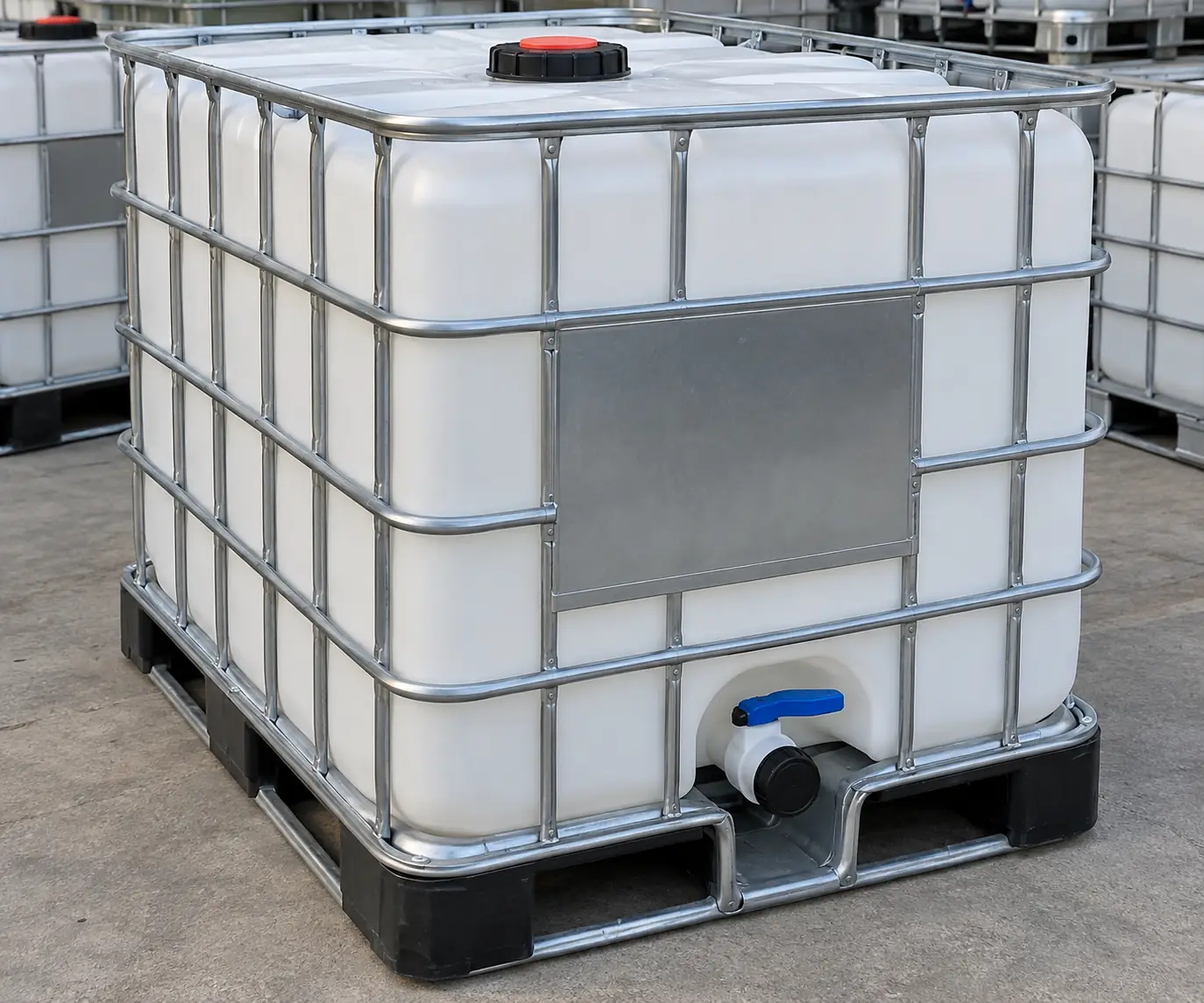
Every illustration on this site is a measured drawing of a real container. Here is the drawing and the photograph side by side, so you can check our work.
Three questions.
One honest verdict.
Reuse as-is
The best outcome there is. Wash it, inspect it, re-release it. No new material, no grinder, no emissions beyond a wash cycle.
- Top band pricing. This is the tote everybody wants and we will quote it the same day.
Figures are per-container averages for a 275-gallon composite IBC, drawn from our own 2025 yard data and published in the annual impact report. Paste the ticket code into the form and the grader will know exactly what you are describing.
Want the long version, with the ladder explained and the sources behind every number? Open the full Loop Lab
Four shelves, one philosophy
Ten services, one loop.
Nothing goes in a hole.
| Size | Footprint | Height | Empty | Full (water) |
|---|---|---|---|---|
| 275 gal / 1040 L | 48 × 40 in | 46 in | 126 lb | 2,420 lb |
| 330 gal / 1250 L | 48 × 40 in | 53 in | 141 lb | 2,890 lb |
| 350 gal stainless | 48 × 42 in | 52 in | 385 lb | 3,300 lb |
| 550 gal stainless | 52 × 46 in | 64 in | 540 lb | 5,130 lb |
The size library we built because nobody else would
Every dimension, weight, thread, valve, pallet type and stacking rating we have collected in fifteen years of handling these things — in tables you can actually read on a phone while standing in a yard.
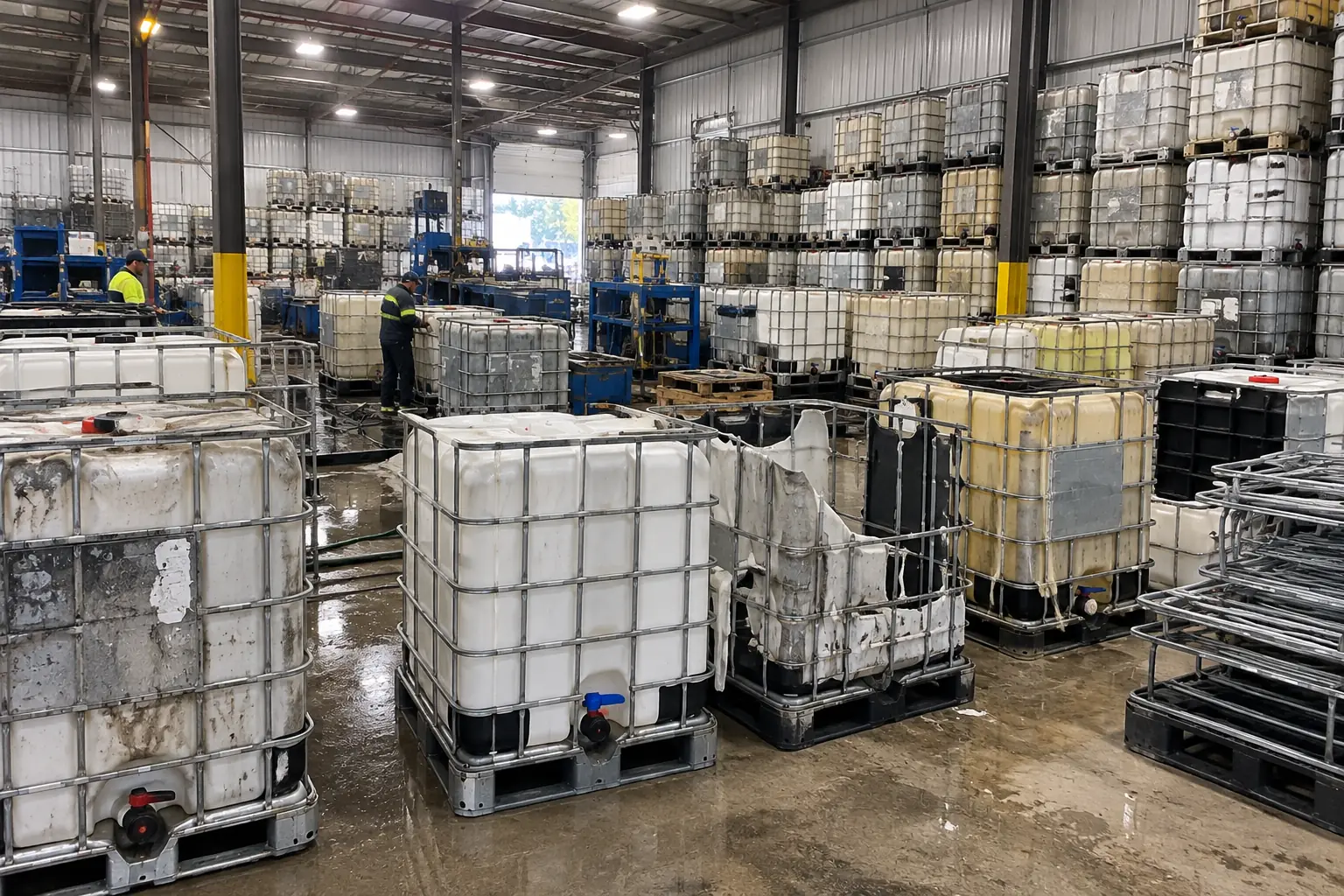
Gate to grade to gone — in five days, typically
You tell us the count
One form. Quantity, last contents, access. That is the whole intake.
We grade off photos
Same grader who will meet the load. The number quoted is the number paid.
We load out
Our truck, our straps, our labour, usually free.
The yard decides
Reuse, rebottle, repurpose or regrind — whichever is highest on the ladder.
Three sentences, no stock photos
“They cleared 380 totes off our pad in two visits and sent a diversion statement our sustainability lead now quotes in board decks.”
Plant manager, specialty chemical blender, Decatur IL“We buy Grade B by the truckload every February. Four seasons in, not one of them has failed in the field.”
Purchasing, agricultural retailer, Galesburg IL“I asked for a weird cut-top with three ports. They sent a sketch back with the parts list and built it in a week.”
Brewery operations, central IllinoisStart from what you have
Most people arrive here with containers they want rid of, or an application and no idea which grade it needs. Either way, this table is the shortcut.
| Your situation | What you want | Where to go | Cost to you |
|---|---|---|---|
| Empties behind the building | Cash and the space back | We buy your totes | We pay you |
| A deadline and containers in the way | Them gone, documented | Pickup & removal | Free on qualifying loads |
| An application and no spec | The right grade first time | The Loop Lab | Nothing |
| Containers with dead bottles | Not to buy new ones | Reconditioning | About half of replacement |
| Food or beverage product | Documents that survive an audit | Food-grade totes | Quoted |
| Solvents or hot fill | A container that will not fail | Stainless IBCs | Quoted |
| A build on a napkin | Somebody who reads napkins | Custom fabrication | Fixed price |
| Numbers for a report | Methodology, not a slogan | Impact calculator | Nothing |
- Address
- 1702 W Chanute Rd, Peoria, IL 61615
- Hours
- Mon–Fri 7:00–17:00 CT · Sat 8:00–13:00 CT
- Service radius
- 300 miles, five states, six standing lanes
- Free pickup
- 12+ containers on a lane; no minimum inside 60 miles
- Minimum order
- 1 for yard collection, 4 local delivery, 12 free lane delivery
- Response
- In writing, usually the same business day
- Telephone
- None — deliberately, since 2019
- Grade warranty
- Below grade on arrival is replaced or refunded
The eight questions we are asked most
How much does a used IBC tote cost?
Between $8 for a scrap cage and $95 for a documented food-grade unit. Grade B — the most common choice, and the right answer for ag, water, glycol and general industrial duty — generally runs $38 to $52 for a 275 gallon container.
Do you really pay for empty containers?
Yes, $8 to $95 each depending on grade, and pickup is free on qualifying loads. Empties are inventory, not waste, and pricing them as waste is exactly how they end up buried.
What is the difference between Grade A, B and C?
A is re-release ready with a documented history and legible markings. B is stained but structurally sound and watertight. C is heavily stained, cosmetically damaged and still holds liquid. The full definitions and the eighteen checks behind them are published.
How can I tell if a container is food grade?
You cannot tell by looking. It needs four documents: FDA-compliant resin certification, a documented food-only contents history, a validated hot-caustic cleaning with a potable final rinse, and a lab verification result. Anything less is a sticker.
Will a 275 gallon tote fit through my door?
Not on its pallet — the footprint is 48 by 40 inches, which beats a 36 inch door. Double doors and roll-ups are fine. People do remove the cage and walk the bottle through, which works and voids any UN rating permanently.
How far do you travel?
Three hundred miles from Peoria, across Illinois, Iowa, Indiana, Missouri and Wisconsin, on six standing lanes. Beyond that we consolidate or quote common carrier honestly rather than calling it free.
Can I stack them?
Empties three high with matching heights and aligned cage posts. Filled, two high and only on rated units. In transit, filled containers travel one high — dynamic loads run three to five times higher than the static rating.
Why is there no phone number?
We removed it in 2019. Everything in writing means every commitment is timestamped and every grade is disputable against a record, and a grader can answer a dozen requests in the time one call takes. Response times improved and disputes nearly vanished.
Reuse first.
Recycle second.
Landfill never.
1702 W Chanute Rd, Peoria, IL 61615. Email us, fill the form, or ask the Loop Lab what your containers should become. There is no phone number because there is no call center — just a yard crew that answers in writing.