Full load sweep
48 totes, strapped and tarped. Best for yards clearing out a quarter's worth of empties at once.
Empties are a space problem before they are a money problem. We clear them out on our own equipment — including the awkward ones stacked three high in a corner behind a rack.
48 totes, strapped and tarped. Best for yards clearing out a quarter's worth of empties at once.
For loading docks and tight industrial parks. 18–24 totes, liftgate available, no yard space needed.
You generate 6–10 empties a month. We add you to a standing route and swap clean for dirty on the same visit.
We run standing routes rather than one-off trips, which is why pickup is free. If you are near one of these lanes, you are near a truck.
| Lane | Anchor cities | Frequency | Lead time |
|---|---|---|---|
| I-74 Corridor | Peoria, Bloomington, Champaign, Danville | Weekly | 3–5 days |
| I-55 North | Lincoln, Springfield, Joliet, Chicago metro | Weekly | 4–6 days |
| I-80 West | Davenport, Iowa City, Des Moines | Biweekly | 6–9 days |
| I-70 South | St. Louis, Effingham, Terre Haute | Biweekly | 6–9 days |
| US-24 Ag Loop | Galesburg, Monmouth, Quincy, Keokuk | Seasonal, weekly Mar–Oct | 4–7 days |
| I-65 East | Lafayette, Indianapolis, Fort Wayne | Monthly or on demand | 8–12 days |
Say the date in the message field. Shutdown and lease-end loads get scheduled against the deadline, not the queue.
Dock or no dock, forklift or no forklift, gate width, truck length restriction, and where the containers are staged. The awkward truth gets the right vehicle sent.
Six standing lanes with fixed frequencies. Your collection joins a route that is already running rather than becoming a dedicated trip.
Three to five days on weekly lanes, six to nine on biweekly, plus two or three in spring. Shutdowns are scheduled against the deadline instead.
In writing, with the arrival window and what they are bringing. If weather or a dry run upstream changes it, you hear before the morning.
| Your access | What we send | Containers per trip | What we need |
|---|---|---|---|
| Dock-high, booked window | Flatbed or dry van | Up to 48 | The window kept |
| Yard with forklift | Flatbed | Up to 48 | Staging space |
| Ground level, no forklift | Box truck with liftgate | Up to 18 | Clear ground access |
| Tight industrial park | Box truck | Up to 18 | Truck length limit stated |
| Farm or field entrance | Flatbed in dry weather | Up to 48 | Which entrance, not the mailing address |
| Soft ground or gravel | Box truck | Up to 18 | Honest conditions in spring |
A dry run — a site described as workable that is not — costs about three hours of lane time and roughly $180. It is the single most preventable cost in this business and one sentence on the form prevents it.
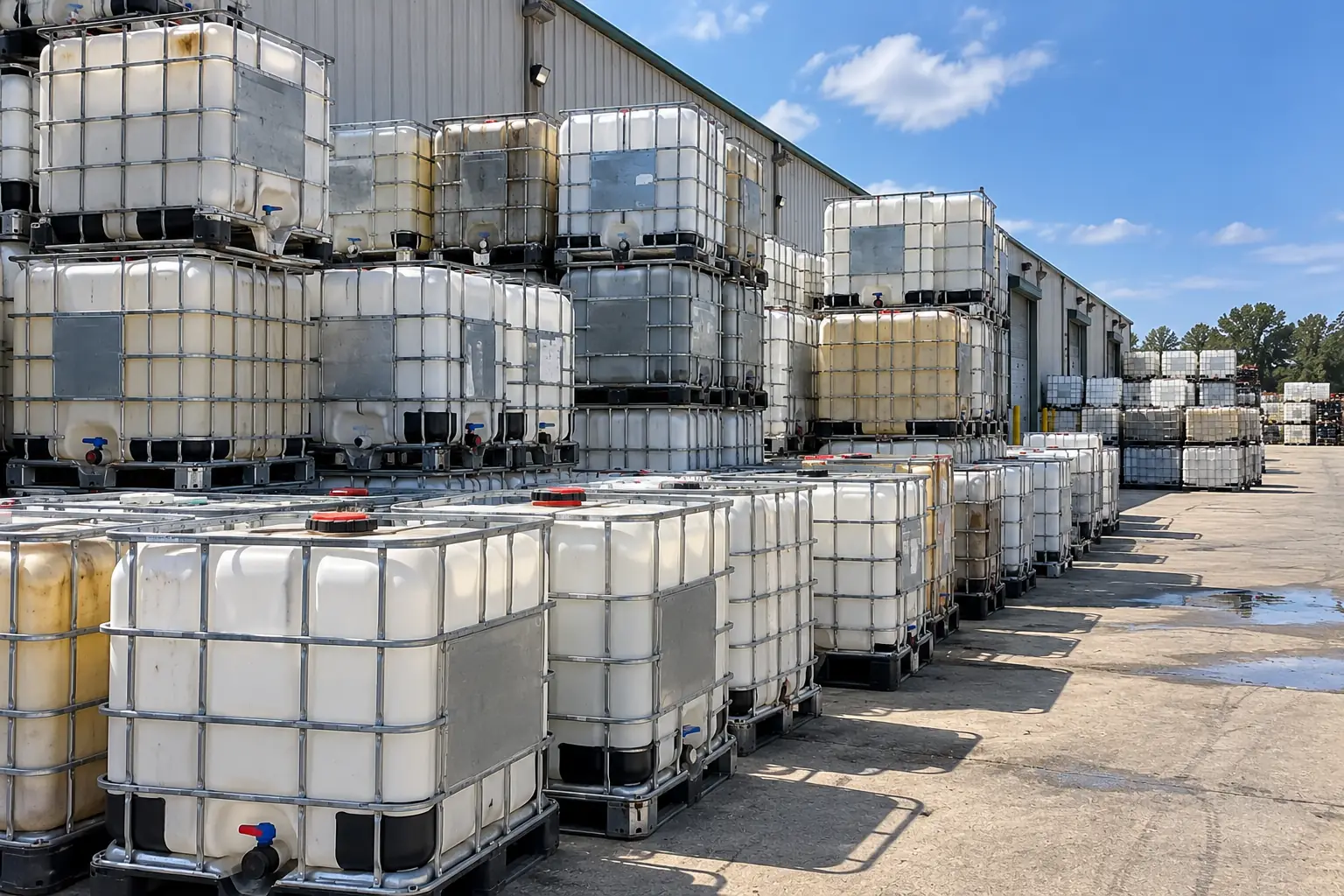
Stacked by height, posts aligned, valve side out, on hard standing if you have it. None of that is a requirement — we have cleared containers out of mud, snowbanks and the back of a collapsed lean-to — but a staged yard turns a two-hour stop into forty minutes, and on a free collection that difference is the whole margin.
A qualifying load is 12 or more totes, or any count inside 60 miles of the yard. Pickup on those loads costs you nothing. Smaller loads outside that range can still be collected, so send the count and location through the form on the contact page.
We bring straps, corner boards, load bars, gloves and a spill kit. We can work from a forklift, a dock, or ground level using our own pallet jack. You only need a gate that opens and somewhere to stage the stack.
Standard lead time is 5 to 8 business days, and 72 hours for emergencies. The exact timing depends on which lane your site sits on, since we run standing routes weekly, biweekly, monthly or seasonally.
Yes. If you generate 6 to 10 empties a month, we can add you to a standing route as a scheduled stop and swap clean totes for dirty ones on the same visit.
Yes. You receive a bill of lading plus a diversion statement, emailed the same day as the pickup. This gives you a record of where the totes went for your own files or audits.