Food grade, rinsed
Clear or natural bottle, food-safe last contents, legible UN markings, no stains. These leave our yard the same week they arrive.
If you have empties stacking up behind the building, they are not waste — they are inventory somebody else needs. We pay for them, load them ourselves, and tell you exactly where they went.
Price is driven by the last contents, the bottle, the cage and whether the tote can be rebottled. We quote all four bands off photos, so nothing changes when the truck shows up.
Clear or natural bottle, food-safe last contents, legible UN markings, no stains. These leave our yard the same week they arrive.
Non-hazardous last contents, triple-rinsed, cosmetic scuffing fine. The biggest band by volume and the easiest to move.
Still watertight, still useful for non-potable work. We buy these for washing, rebottling and upcycle builds.
Cracked bottle, failed valve, mystery residue. We still take it: cage gets reused, bottle becomes regrind. We just pay scrap.
Send four photos — placard, valve, top fitting and a wide shot of the stack. We grade them in a day and quote a per-tote price with the pickup window attached.
Quantity, last contents and dock access. That is the whole intake.
Photos go to the same grader who will inspect them on arrival, so the number holds.
Our flatbed, our straps, our labor. You keep your forklift on your own work.
Payment on pickup or net-15, plus a diversion statement for your ESG file.
“A tote is the rare piece of industrial packaging that can live four or five lives. Burying one at life two is a design failure, not a disposal decision.”
— Yard floor rule #1
No. On qualifying loads — generally 12 totes or more within our 300-mile radius — pickup is free and comes off the same route that delivers reconditioned units.
Most Illinois, Iowa, Indiana and Missouri pickups land within 5–8 business days. Peoria-area loads are often same-week because the yard is here.
Not as-is. We can coordinate licensed disposal of the remaining product first, then buy the empty container. That keeps your generator status clean.
A per-load diversion statement with tote counts by grade, destination path (reuse, rebottle or regrind) and estimated landfill avoided in pounds.
| Factor | Effect on price | Why | Can you change it? |
|---|---|---|---|
| Documented last contents | +30–60% | Without it the container cannot re-enter product service | Yes — write it down |
| Legible UN plate | +30–60% | An anonymous container is out of regulated service permanently | Photograph it, never paint it |
| Documented rinse | +1 price band | Saves us a cycle and proves the residue | Yes — send the records |
| Indoor storage history | +1 band typical | UV plus flex is what crazes a bottle | Partly |
| Count on one site | Better per-unit | One stop instead of four | Yes — consolidate |
| Matching sizes stacked | Better freight | Mixed heights halve what a trailer carries | Yes — stage by height |
| Valve present and capped | Small premium | Correlates with everything else being cared for | Yes |
| Resin market | Moves bands quarterly | Regrind and new-container prices set the floor and ceiling | No |
| Season | Up to 24% across a year | Our inventory peaks in January and empties in May | Yes — time it |
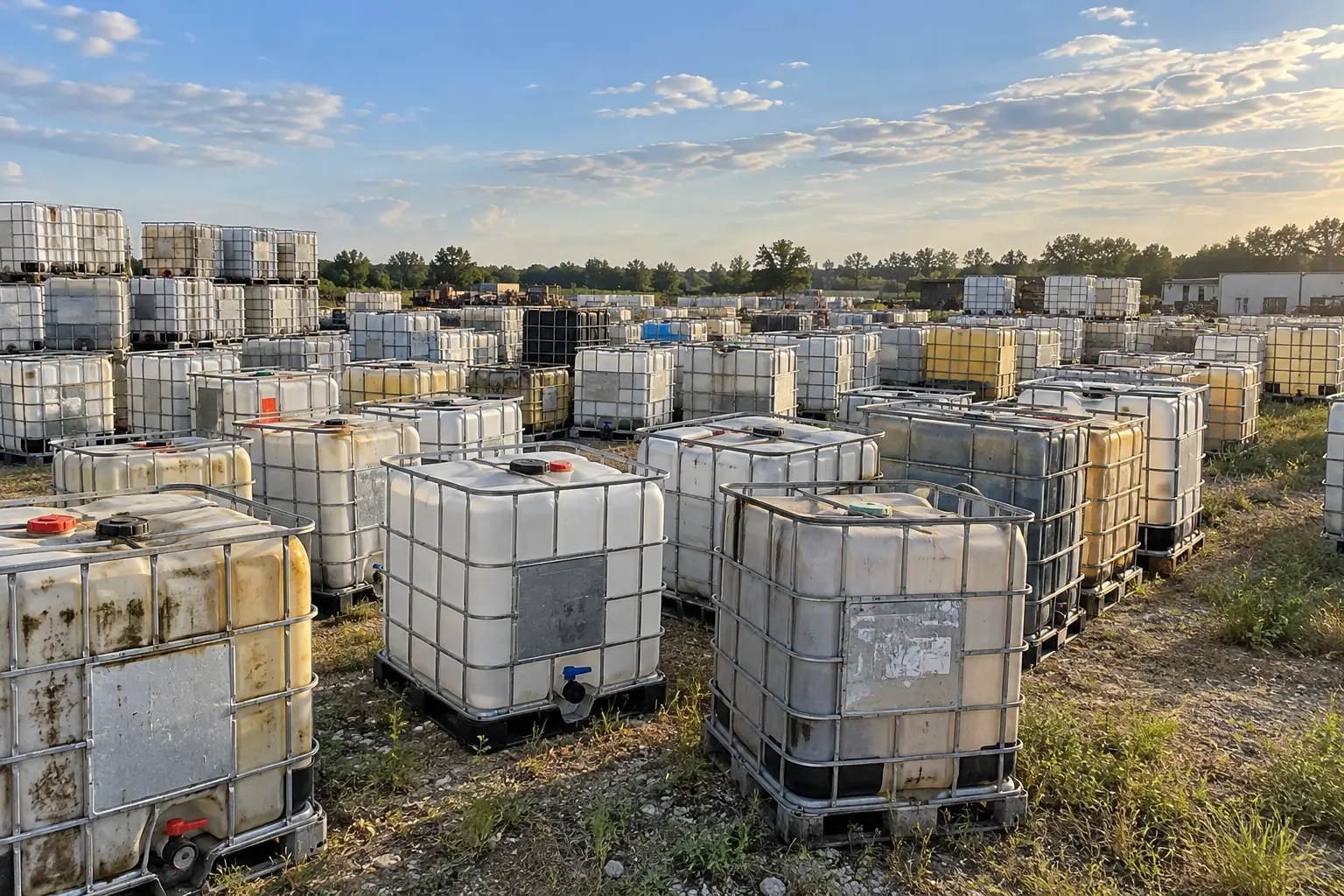
Nobody needs to clean containers up before we look at them. Stains are cosmetic, weathering is normal, and a yard that has been accumulating empties for two years is exactly the job we want. What changes the price is not how they look — it is whether you can tell us what was in them and how they have been stored.