The bottle
Granulated to 8–12 mm regrind, washed, dried and sold to moulders making pipe, pallets, drainage and non-food containers.
Recycling is our second choice, not our first — every tote we grind is a tote we could not save. But when a bottle is cracked or chemically spent, grinding it back to pellet beats every alternative by a wide margin.
Granulated to 8–12 mm regrind, washed, dried and sold to moulders making pipe, pallets, drainage and non-food containers.
Sheared, baled and sent to regional mills. Galvanised tube is a clean, high-yield scrap stream.
Re-decked and reused when sound; chipped for mulch and boiler fuel when not.
Sorted by polymer and metal. Brass and stainless fittings go to metal; poly valves join the regrind stream.
| Output | Spec | Typical destination | Volume share |
|---|---|---|---|
| Natural HDPE regrind | 8–12 mm, <1% moisture | Pipe & profile extrusion | 54% |
| Mixed-colour HDPE regrind | 8–12 mm, colour sorted | Pallets, drainage, crates | 22% |
| Baled galvanised steel | Mill-ready bales | Regional EAF mills | 18% |
| Wood fibre | Chipped | Mulch, boiler fuel | 4% |
| Residual | Sludge, gasket, labels | Licensed processor | 2% |
For brand-protected or contaminated containers we grind on a witnessed basis and issue a certificate of destruction with weights and photos.
| Reason | Share | Avoidable? | What would have prevented it |
|---|---|---|---|
| Bottle crazed or split beyond rebottling value | 29% | Partly | Covered or indoor storage |
| Solvent or fuel absorption | 20% | No | Chemistry decided this at the filler |
| Undocumented history, no resale path | 15% | Entirely | A written last-contents declaration |
| Contaminated residue, not washable | 12% | Partly | On-site rinsing before pickup |
| Structural cage failure plus bottle damage | 10% | No | — |
| Brand-protected destruction requested | 8% | No | The customer required it |
| Cut, drilled or modified previously | 6% | Entirely | Never modify a sound container |
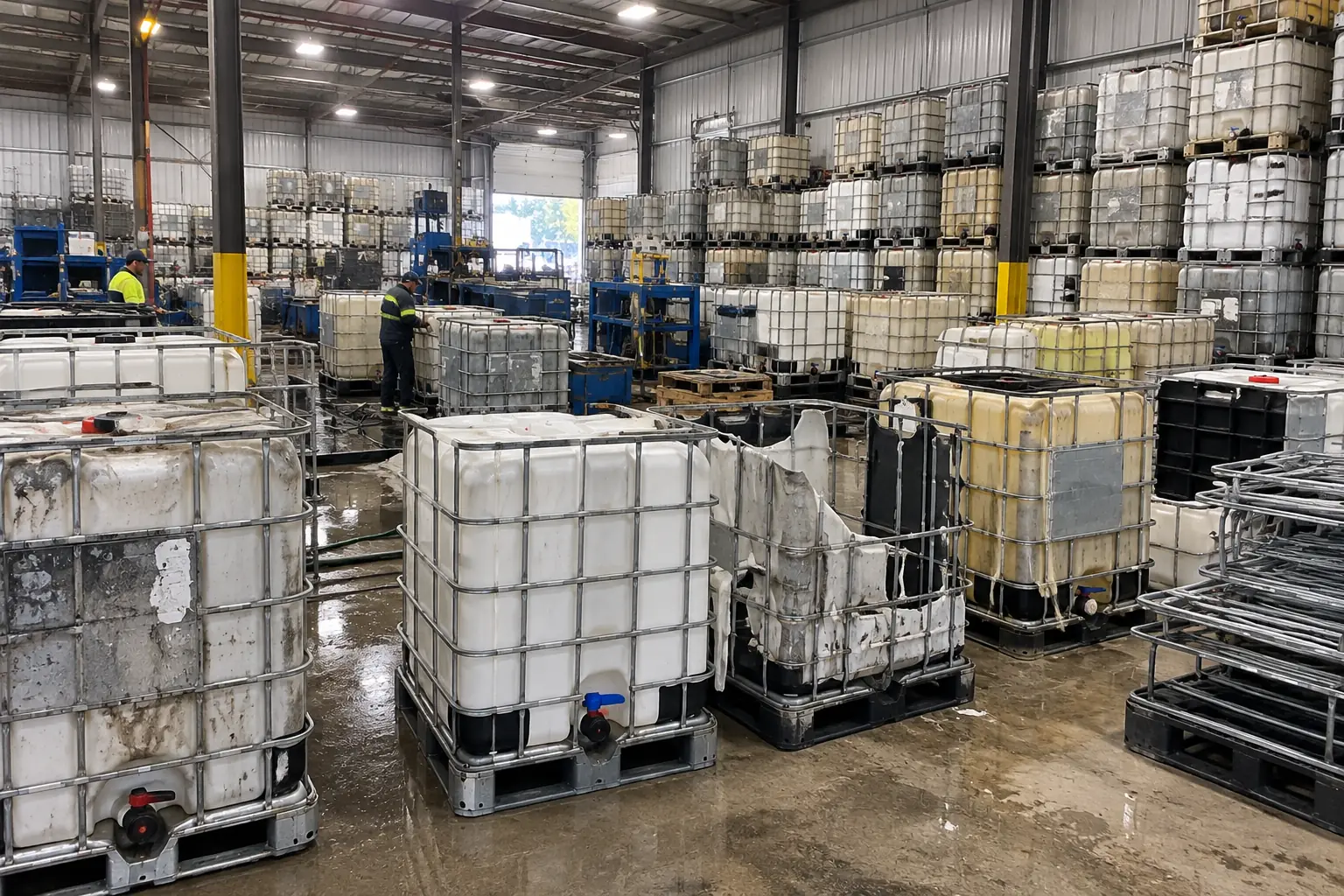
Valves and fittings off, bottle out of the cage, cage to the baler and polyethylene to the granulator. Every container in this frame failed grading for product service — and even so, the only thing leaving the site as waste is gasket rubber, label adhesive and filter media.
The HDPE bottle is granulated into 8 to 12 mm regrind, the steel cage is sheared and baled for regional mills, and the pallet is reused if sound or chipped if not. Hardware is sorted by polymer and metal.
Reuse comes first. We work down a ladder: reuse as is, rebottle, repurpose, then recycle. Recycling is our second choice, used when a bottle is cracked or chemically spent.
Yes. For brand-protected or contaminated containers we grind on a witnessed basis and issue a certificate of destruction with weights and photos. Request it through the form when you book.
Natural HDPE regrind goes mostly to pipe and profile extrusion. Mixed-colour regrind goes to makers of pallets, drainage and crates. It is sold to moulders for non-food products.
Common reasons are crazed or split bottles, solvent or fuel absorption, and no documented history. A written last-contents declaration and covered storage would have prevented many of them.