Reconditioning
Reconditioning is where the environmental math actually happens. A rebottled tote reuses roughly 60% of the original container by weight — the entire steel cage and pallet — while costing a fraction of new.
- Sheet
- 39
- Revision
- 2026-10
- Scale
- 1:1
- Drawn at
- Peoria IL
What happens between the gate and the rack
Intake & de-label
Every tote is photographed, its UN code logged and its last-contents declaration filed before it moves an inch.
Teardown
Bottle out, valve out, gaskets out. Cage and pallet go one way, polyethylene goes the other.
Wash or regrind
Bottles that can be reused get the closed-loop triple rinse. Bottles that cannot become regrind.
Cage work
Bars straightened on a jig, welds re-run, rust wire-wheeled and the pallet re-decked if it is composite or steel.
Rebuild
New or washed bottle seated, fresh EPDM gaskets, new ball valve, new lid, torque to spec.
Test
Leak test under head pressure, valve cycle test, stack-load spot check on 1 in 20.
Re-mark
New placard, grade sticker, internal serial, and the UN marking verified against the rebuild.
Rack & release
Palletized, wrapped if requested, and logged into inventory with the grade it earned, not the grade it arrived with.
Why 60% reuse beats 100% new, every time
| Measure | New composite IBC | Rebottled IBC |
|---|---|---|
| Embodied CO₂e | ≈ 262 lb | ≈ 50 lb |
| Virgin HDPE used | 134 lb | 0–134 lb (0 if bottle washes) |
| Steel cage | New, 60 lb | Reused |
| Pallet | New | Reused or re-decked |
| Typical cost index | 100 | 42–58 |
| Service life after work | 5–8 years | 4–6 years |
Parts we fit as standard
- Outlet valve
- 2" butterfly or ball, S60x6 or NPT, EPDM seat
- Top fitting
- 6" buttress cap, vented or solid, with tamper ring
- Gaskets
- EPDM standard; Viton on request for solvents
- Bottle
- Natural HDPE, 60–70 mil wall, UV-stabilised
- Cage
- Galvanised tubular steel, 10–12 bar configuration
- Pallet options
- Composite, full steel, or plastic 2-way / 4-way entry
Can a reconditioned tote carry a UN-rated product?
Yes, when the original marking is intact and the rebuild is documented. We only re-release UN-marked totes with a matching rebuild record, and we will not re-mark a container that has lost its original code.
Do you recondition my own totes and send them back?
That is our toll-reconditioning service. Your containers, your serials, your branding — they come back to you with a rebuild record instead of going into general inventory.
How clean is clean?
Our standard is a triple rinse with validated detergent and a visual plus swab check. For food-grade release we add a potable-water final rinse and documentation.
Your containers back, not somebody else's
Toll work means your own serials go through the line and come back to you with a rebuild record, rather than entering our general inventory. Branded fleets, pooled assets and anybody with documentation continuity to protect uses this route.
| Toll reconditioning | Buy reconditioned | |
|---|---|---|
| Who owns the containers | You, throughout | You, after purchase |
| Serial continuity | Preserved | New serials |
| Branding | Reapplied to your artwork | Ours or plain |
| Documentation | Appended to your existing record | Starts with us |
| Lead time | 1–2 weeks plus freight both ways | From stock |
| Cost basis | Per operation performed | Per container |
| Best for | Branded or pooled fleets | General replacement |
- Minimum toll batch
- 12 containers
- Turnaround at the yard
- 4–7 working days
- What you get back
- Rebuild record per serial, leak test result, parts list
- Branding
- Placards or wrap reapplied, never across the UN plate
- Containers we will refuse
- Anything whose residue we cannot characterise
- Freight
- Both directions on our lanes where you are on one
Where a container is taken apart
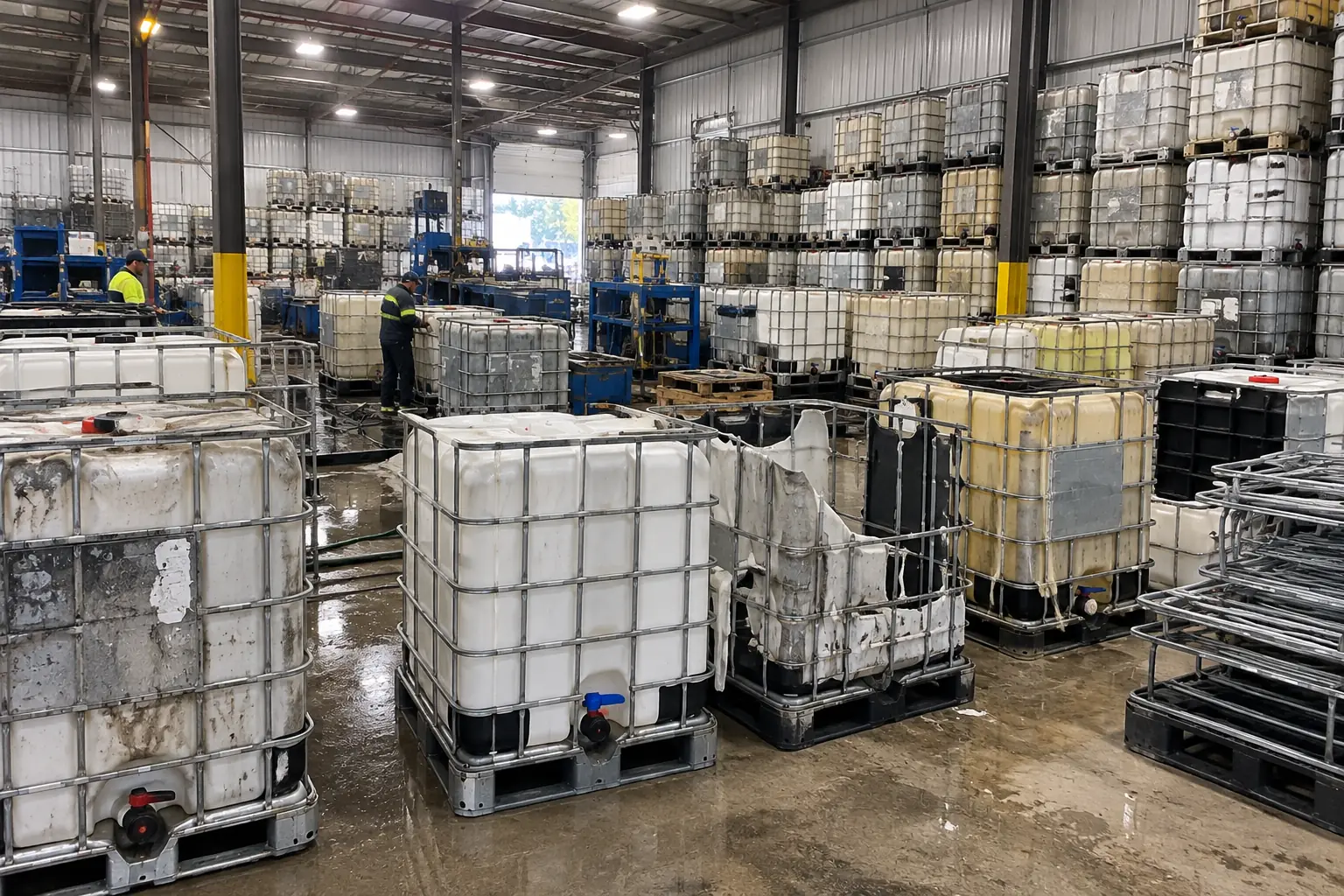
Wet containers have just come off a cycle. The stripped bottle in the middle of the frame is on its way to the granulator and its cage is going to the jig — one failed container, two useful outcomes. The stacks along the far wall are graded units waiting for hardware, which is the largest category in the building and the cheapest work we do.