Sump bulge
The lower container's bottle takes load through the base. Permanent deformation; the container is a rebottle candidate from then on.
One principle, seven limits, four failure modes. This page exists because we take in dozens of containers a year that were destroyed by a stack somebody thought would be fine.
Every stacking rule in this industry is a restatement of that single sentence. Once you internalise it, you can derive the rest yourself.
| Situation | Limit | Why |
|---|---|---|
| Empty, aligned cage posts | 3 high | Cage carries load in compression through the posts |
| Empty, misaligned | 1 high | Load path goes through the bottle, which deforms |
| Filled, rated units | 2 high | Static load rating on most 31HA1 designs |
| Filled, unrated or unknown | 1 high | No rating means no stacking, full stop |
| In transit, filled | 1 high | Dynamic loads are several times static |
| In transit, empty | 2 high with securement | Strapped and corner-boarded only |
| Racked on beams | Per rack rating | Check the pallet type supports beam loading |
The lower container's bottle takes load through the base. Permanent deformation; the container is a rebottle candidate from then on.
The frame goes out of square, so nothing above it sits flat and the whole stack walks over a few weeks.
Load concentrated at a corner post joint. Repairable on a jig, but the container is out of service until it is.
The failure nobody notices: a filled double stack slowly shortens over a month, then fails all at once.
Empty: three high. Filled: two high, and only if the unit is rated. In transit: one high filled. Everything else is somebody rationalising a shortcut.
| Rating | Typical 275 gal | Typical 330 gal | Where to find it | Applies when |
|---|---|---|---|---|
| Max gross mass | 1,100–1,250 kg | 1,350–1,500 kg | UN plate | Always |
| Stacking test load | 1,800–2,400 kg | 2,200–2,800 kg | UN plate or separate plate | Static, warehouse only |
| Permitted stack, empty | 3 high | 3 high | Convention, not the plate | Posts aligned, same height |
| Permitted stack, filled | 2 high | 2 high | Only if the plate states it | Static, rated units only |
| Permitted stack, in transit | 1 high filled | 1 high filled | Carrier practice | Always |
| Hydrostatic test pressure | 20–25 kPa | 20–25 kPa | Design type record | Type approval only |
| Method | Capacity | Advantage | The mistake people make |
|---|---|---|---|
| Pallet rack, beam supported | 2 per bay | Dense, valve access on every unit | Pallet not rated for beam support |
| Pallet rack, full decking | 2 per bay | Works with any pallet type | Deck rating ignored |
| Floor stack, empty | 3 high | Free, fast | Mixed heights, misaligned posts |
| Floor stack, filled | 2 high max | No equipment needed | Unrated units, or creep unnoticed |
| Bare ground outdoors | 1–2 high | None | Base-rail rust, the one unrepairable failure |
| Dedicated tote rack | 2–3 high | Designed for the job | Rarely cost-justified under 100 units |
In a warehouse, standing still, on level concrete, with the posts aligned — yes, that is exactly what the rating is for. In a trailer, no, because dynamic loads run three to five times higher and the rating was never measured under those conditions.
The stacking load appears on the UN plate or on a separate plate near it. If it is not stated, treat the container as unrated and single-stack it when full.
With matching heights and aligned posts, on level ground, yes — it is standard practice everywhere. Misalign them and the third tier becomes a lever on the bottom container's bottle.
No. A composite IBC needs its corner posts landing on something that can take point loads at those four positions. Drums and crates do not provide that.
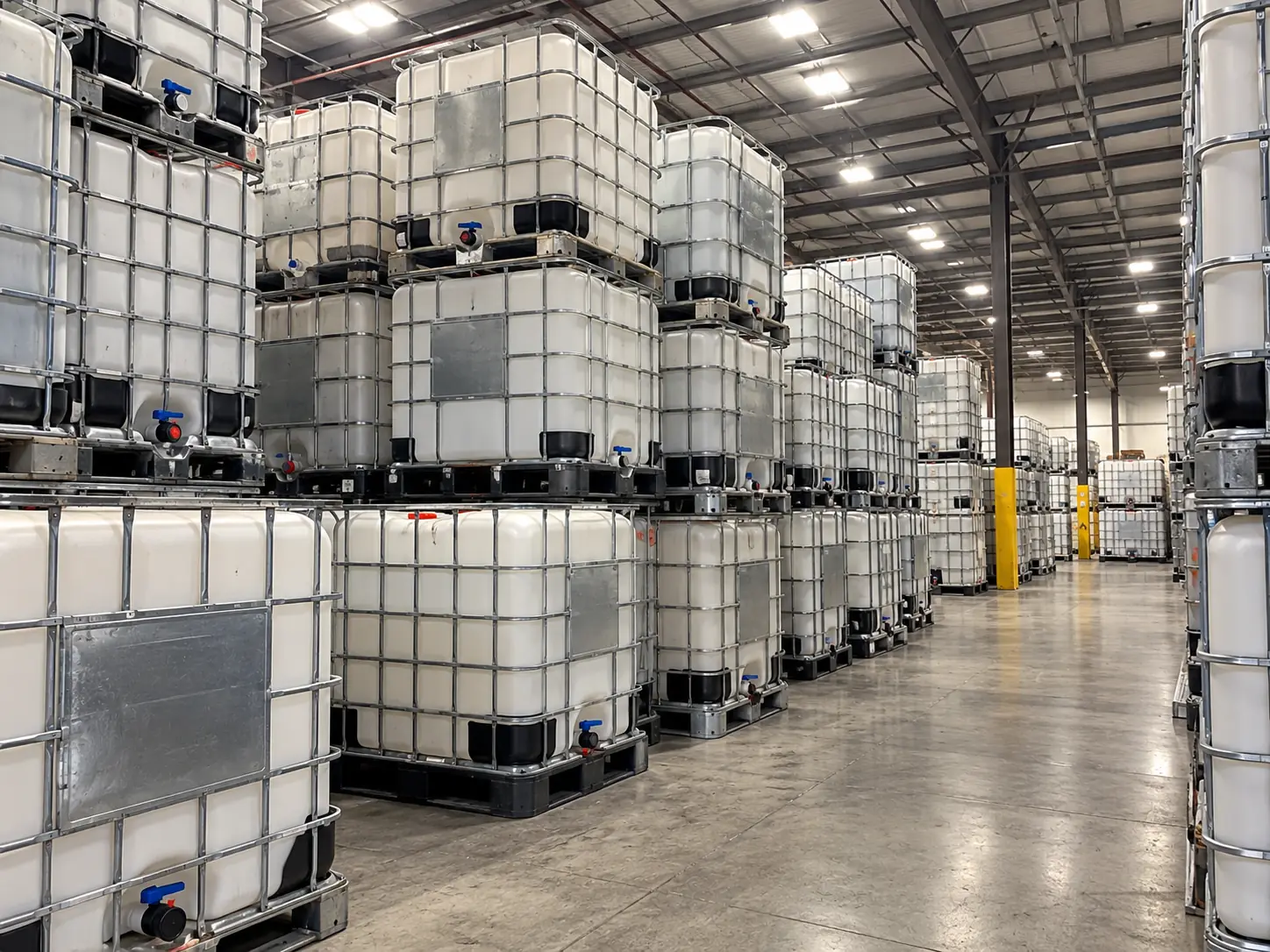
This is the rule working: identical heights in every stack, corner posts landing on corner posts, valves facing the aisle so a weep is visible without moving anything. Mix a 330 into a column of 275s and the upper container's posts land between the lower one's — straight into the bottle shoulder, which is how a sump gets permanently deformed.