Inside the Peoria yard
Four acres on West Chanute Road where containers arrive as somebody's problem and leave as somebody's inventory.
- Sheet
- 07
- Revision
- 2026-10
- Scale
- 1:1
- Drawn at
- Peoria IL
Six stations, one direction of travel
Containers move in a straight line through the yard. Nothing goes backwards, because a tote that has to be re-handled is a tote losing money and emitting carbon for no reason.
Intake pad
Every container photographed, serial logged, last-contents declaration matched to the load. Anything undocumented gets quarantined, not guessed at.
Grading line
Eighteen checks under good light. Each tote leaves this station with a letter, a path and a sticker.
Wash bay
Three bays, closed-loop water, hot caustic available. 6,000-gallon sump underneath the whole thing.
Rebottling
Teardown, cage jig, new bottle and hardware, leak test. The station that saves the most containers.
Fab shop
Cutting, bulkhead fittings, manifolds, insulation, branding. Where totes stop being totes.
Granulator
The end of the line, and the one we try hardest not to use. HDPE in, 8–12 mm regrind out.
- Address
- 1702 W Chanute Rd, Peoria, IL 61615
- Yard size
- Just under 4 acres, 2.1 acres paved
- Covered storage
- 11,000 sq ft, racked three high
- Wash bays
- 3, with a 6,000-gal recovery sump
- Standing inventory
- 1,800–3,400 containers depending on season
- Yard visits
- By appointment — email us and pick a morning
Things visitors always ask about
Why is the gravel area so small?
Because gravel means runoff we cannot account for. Every square foot of the working yard drains to the recovery sump, which is why paving it was the first capital project after the wash bay.
What is the smell test about?
An experienced grader can identify glycol, vegetable oil, surfactant and solvent residue by smell faster than any instrument we could afford. It is not a substitute for documentation — it is how we catch declarations that do not match reality.
Why are totes stored valve-out?
So a weep is visible from the aisle. Finding a leaking valve behind a stack means moving the stack; finding it from the aisle means a five-minute gasket change.
Can I walk the yard?
Yes, by appointment, in closed-toe shoes, during business hours. Most of our larger customers have done it, and several changed their specification afterwards.
The yard has four completely different personalities
| Season | What dominates | Inventory | Best time to |
|---|---|---|---|
| Winter (Dec–Feb) | Reconditioning backlog | High | Buy for spring at the year's best price |
| Spring (Mar–May) | Outbound ag rush | Falling fast | Have ordered already |
| Summer (Jun–Aug) | Empty pickups | Rising | Sell us your empties |
| Autumn (Sep–Nov) | Fabrication & harvest builds | Mixed | Order custom work |
Everything on site, and what it is for
| Equipment | Count | What it does | Capacity per day |
|---|---|---|---|
| Grading stations under fixed lighting | 2 | Eighteen checks, five photographs, grade sticker | 150–200 containers |
| Wash bays with recovery drainage | 3 | Cycle 1, 2 and 3 washing | 24–33 cycles |
| Recovery sump | 1 (6,000 gal) | Capture, separate, settle | Continuous |
| Two-stage filtration | 1 train | 25 micron bag, 5 micron cartridge | Continuous |
| Rebottling benches | 2 | Teardown, rebuild, leak test | About 35 containers |
| Cage straightening jig | 1 | Returns frames to square | 20–30 cages |
| Granulator | 1 | HDPE to 8–12 mm regrind | About 20 containers |
| Baler | 1 | Mill-ready galvanised steel bales | As needed |
| Fabrication bay | 1 | Cutting, ports, manifolds, branding | 8–12 builds |
| Forklifts | 2 | 5,000 lb and 8,000 lb rated | — |
| Flatbed and box truck | 2 | 48 or 18 containers respectively | 1–2 lanes |
| Truck scale | 1 | Weight tickets on any load | — |
- Paved working area
- 2.1 acres, all draining to the recovery sump
- Covered storage
- 11,000 sq ft, racked three high
- Outdoor racking
- Concrete only — nothing stored on bare ground
- Turning room inside the gate
- Sufficient for a 53 ft trailer
- Storm system discharge
- Zero — the claim we would most like audited
- Quarantine area
- Segregated, bunded, for undeclared or disputed containers
Why the yard runs in one direction
The single biggest operational improvement we have made in five years was not equipment. It was moving the grading line so that containers travel in a straight line from the gate to the outbound rack with no backtracking. A container that has to be re-handled is a container losing money and emitting carbon for no reason, and before the change some units crossed the yard four times.
Intake pad
Nearest the entrance, because unloading a truck fast is how you keep a standing lane on schedule.
Grading line
Under fixed lighting, immediately after intake. Grading in bad light is how you create a dispute three weeks later.
Wash, rebottle, quarantine
Sorted containers go left or right from the grading line, never back towards the gate.
Fab bay and granulator
Both terminal paths. Nothing that reaches this end of the yard comes back up it.
Racking and load-out
On the exit side, so a finished container never crosses the yard twice.
Can I bring my own truck and collect?
Yes, by appointment during business hours. Bring straps and corner boards; we will load you with our forklift and provide a weight ticket if you want one.
Is there somewhere to wait?
There is an office with coffee and a view of the grading line, which several customers have found more interesting than they expected.
What should I wear?
Closed-toe shoes, minimum. High-visibility vests are provided at the office. If you want to see the wash bay, bring eye protection or borrow ours.
Can I see the records while I am here?
Yes — say so when you book and we will have the cycle logs, diversion worksheets and mill tickets out. Four customers have done exactly that.
How long does a visit take?
An hour covers the whole operation at a walking pace. Two if you want to watch a rebottle from teardown to leak test, which is the part most people end up asking for.
What four acres of containers actually looks like
Three plates from an ordinary working week — the covered storage, the load-out apron and the reconditioning floor.
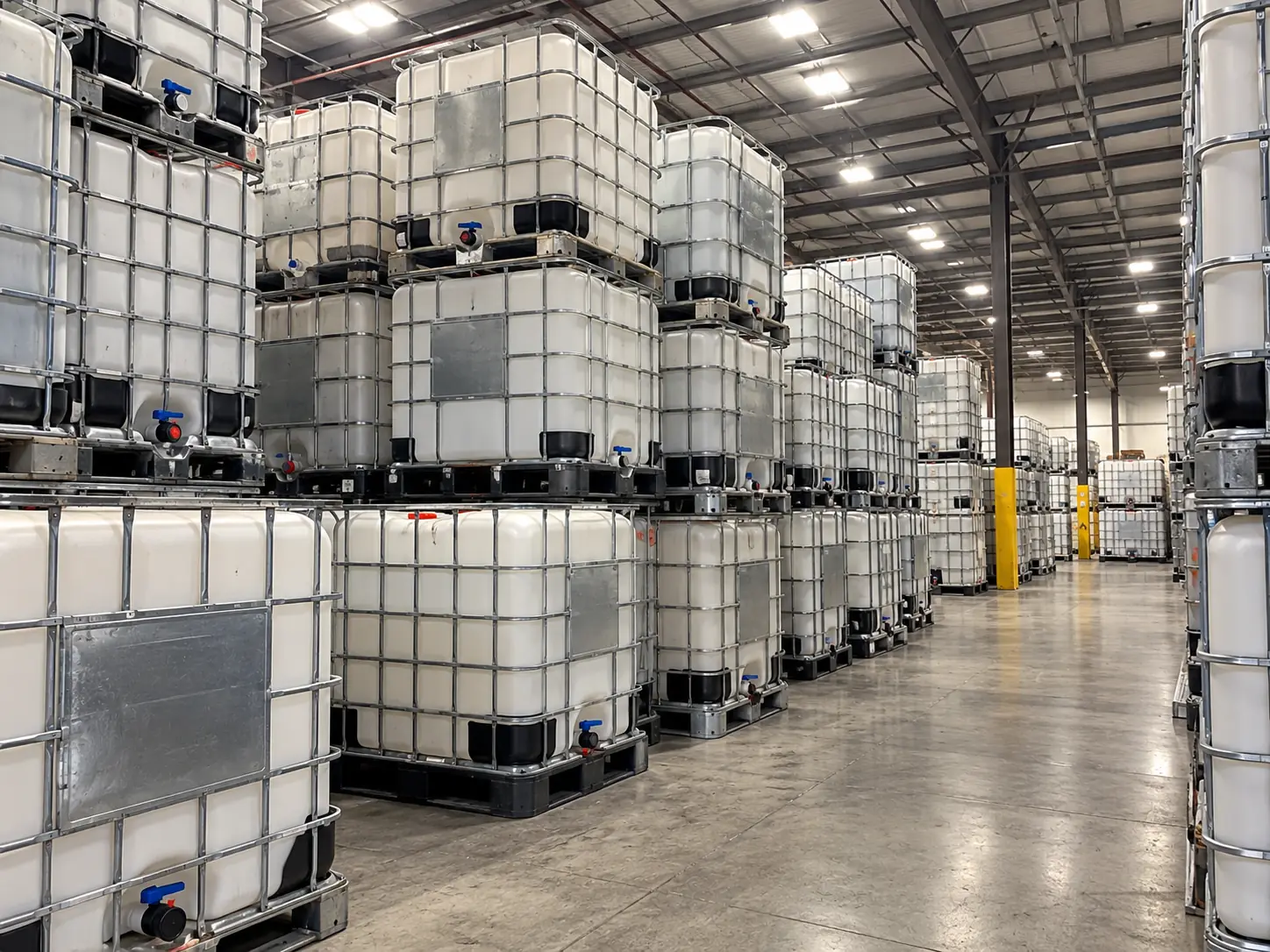
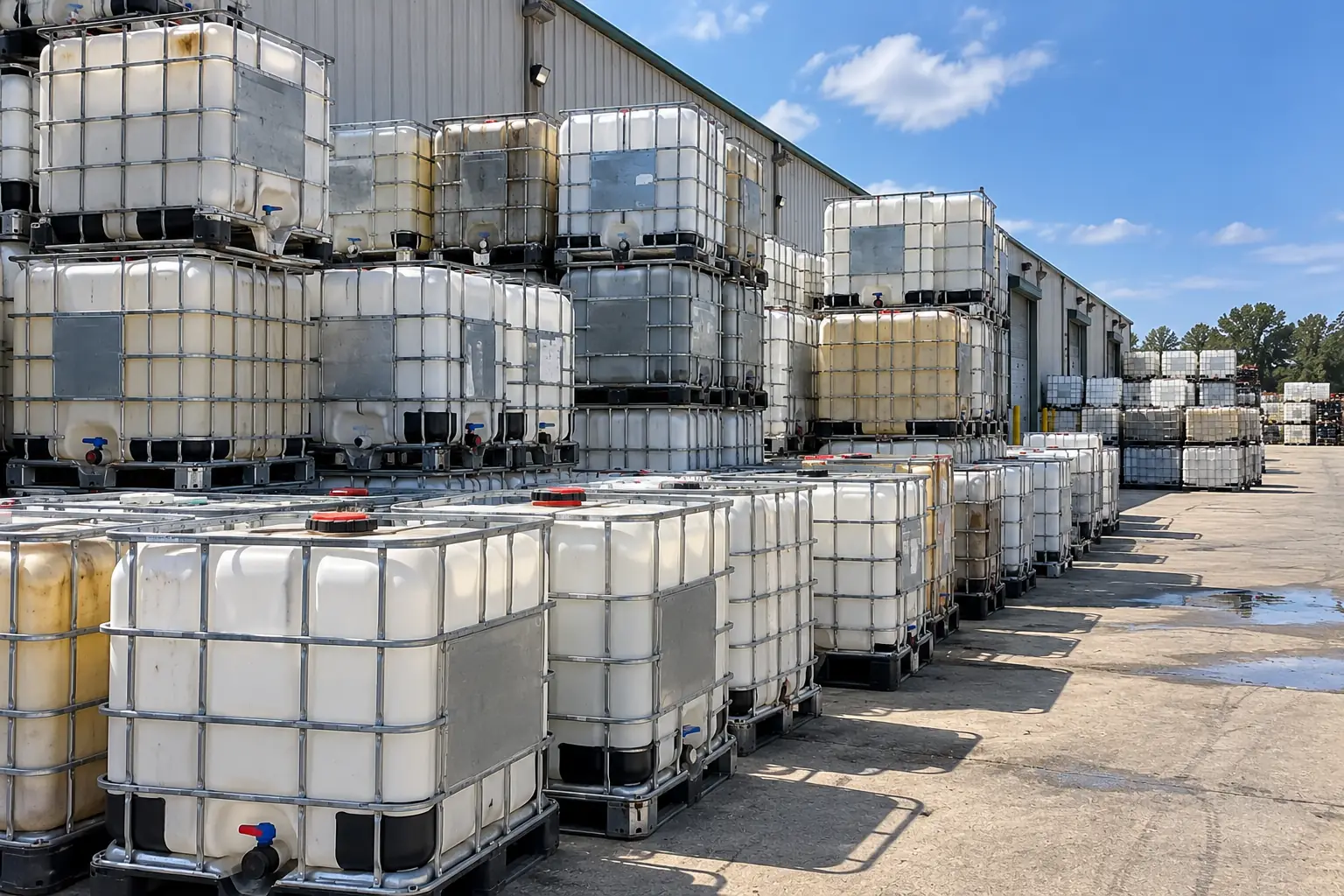
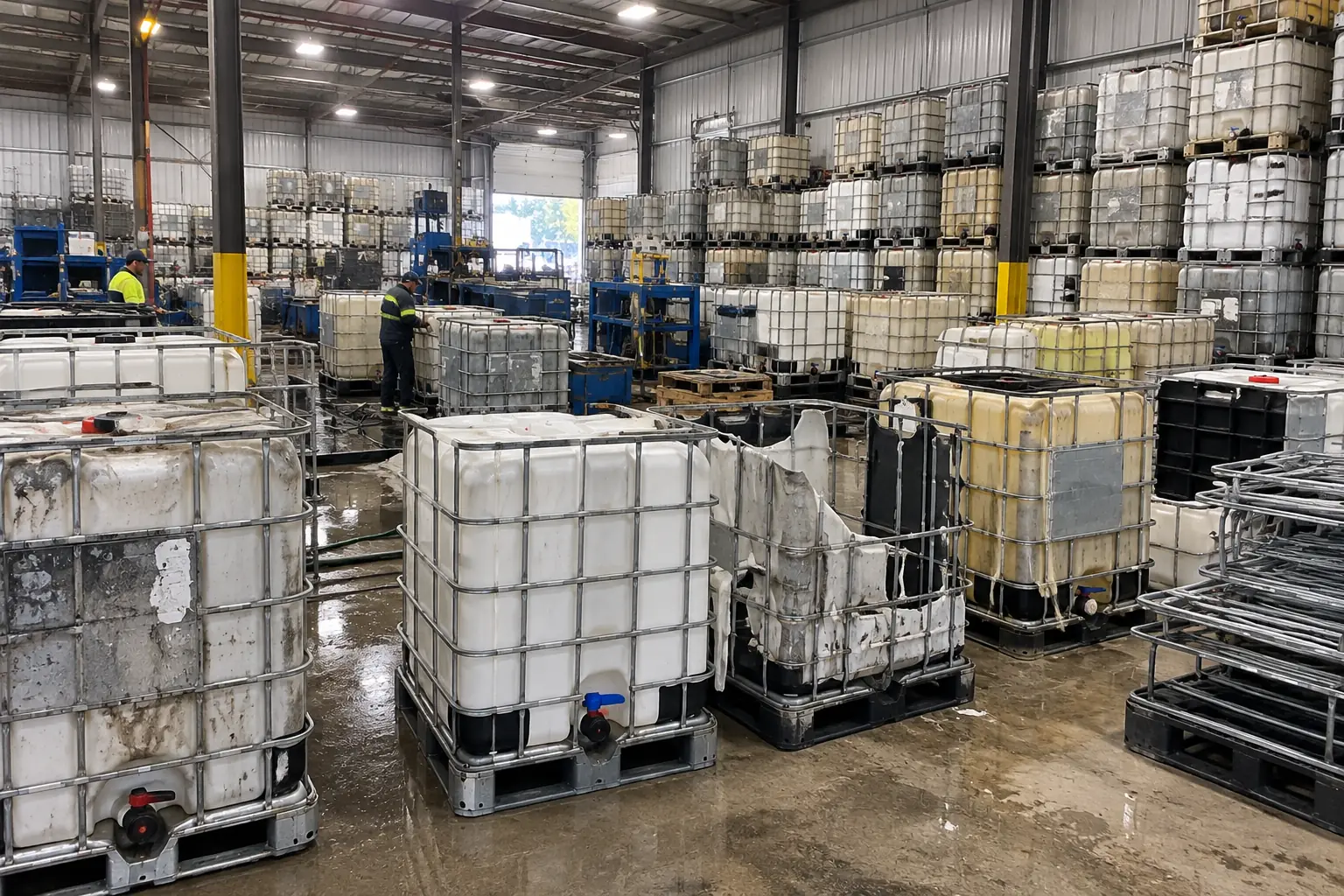
Nothing in these frames is staged. The containers on the reconditioning floor are wet because they have just come off a cycle, the cages stacked against the far wall are waiting for jig work, and the stripped bottle in the middle is on its way to the granulator. That is a normal Tuesday.